
AI in PLM
AI in Product Lifecycle Management (PLM): Applications, Industry Use Cases, Technologies, and Trends
How AI is transforming PLM in 2026: applications, industry use cases, core technologies, and the shift to governed AI agents.
Kajol JaiswalMarketing Executive
18 min read
Introduction
Artificial intelligence is rapidly becoming a core capability of product lifecycle management (PLM). In 2026, leading PLM vendors including Siemens, Dassault Systèmes, PTC, and Aras have each introduced AI assistants or AI agents directly within their platforms, enabling organizations to search, analyze, and act on product data in ways that were not possible with traditional PLM tools.
As AI moves from pilot projects into everyday engineering workflows, organizations are evaluating where it delivers measurable business value, which technologies it relies on, and how it can be adopted wh
ile protecting product data, intellectual property, and regulatory compliance.
This guide explains what AI in PLM is, how it improves each stage of the product lifecycle, its key applications and industry use cases, the technologies that power it, its benefits and challenges, and the trends that will shape its development in the years ahead.
Key takeaways
- AI in PLM applies artificial intelligence to product data such as requirements, CAD models, BOMs, and change records, helping teams find information faster, reduce errors, and automate routine engineering work.
- AI supports every stage of the product lifecycle, and knowledge search and part reuse typically deliver the earliest returns.
- In 2026, Siemens Teamcenter, Dassault Systèmes 3DEXPERIENCE, PTC Windchill, and Aras Innovator all introduced built-in AI assistants or AI agents.
- The next phase is agentic PLM, in which AI agents carry out tasks such as BOM and change management while people approve key decisions.
- Clean, connected, and well-governed product data is the most important factor in the success of AI in PLM.
What Is AI in Product Lifecycle Management (PLM)?
Product lifecycle management (PLM) is the discipline and software that organizations use to manage all product data and processes, from the initial concept through design, manufacturing, service, and eventual retirement. A PLM system serves as the single source of truth for drawings, specifications, documents, BOMs, and change history, and connects the engineering, manufacturing, quality, and supply chain teams that work with them.
AI in product lifecycle management, or AI in PLM, refers to the application of artificial intelligence to the product data and processes managed within a PLM system, including requirements, CAD models, bills of materials (BOMs), engineering changes, quality records, and service information. It enables organizations to find, interpret, and act on product information faster, while reducing manual effort across the product lifecycle.
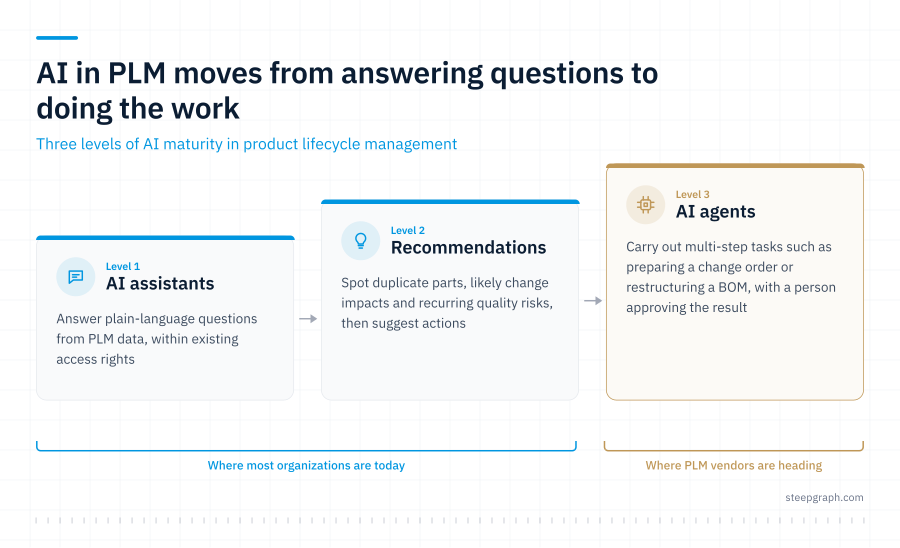
AI capabilities in PLM generally operate at three levels of maturity. AI assistants allow users to query product data in natural language, such as identifying which assemblies use a specific part, with existing access controls respected.
AI recommendations analyze historical and current product data to identify patterns such as duplicate parts, likely change impacts, and recurring quality issues, and then suggest appropriate actions. AI agents go further by executing multi-step tasks, such as preparing an engineering change order or restructuring a BOM, with designated users reviewing and approving the outcome.
Most organizations currently use AI at the assistant or recommendation level. PLM vendors are now advancing toward agent-based capabilities, which offer the greatest productivity gains but also require stronger data governance and process controls.
How Does AI Improve Each Stage of the Product Lifecycle?
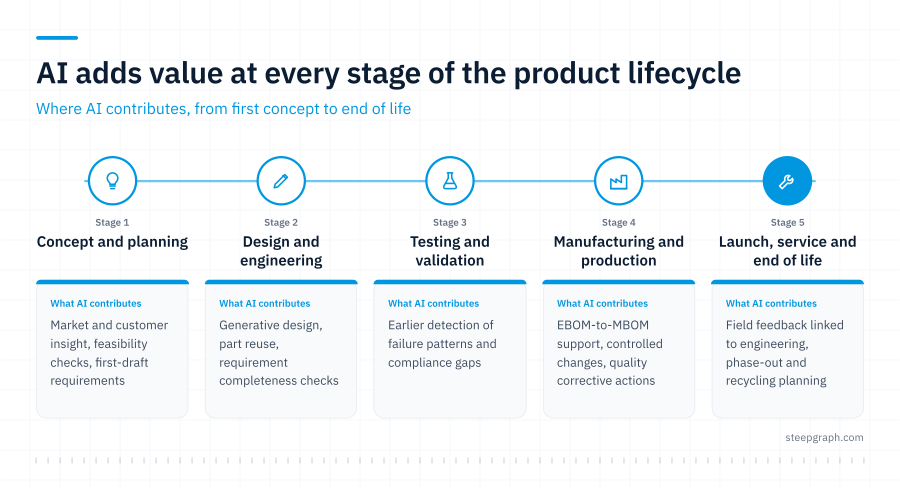
AI, and generative AI in particular, now supports every stage of the product lifecycle, from the first product idea to end-of-life planning. The value it adds differs at each stage, as do the teams that benefit.
Concept and planning
In the early stages, AI analyzes market data, customer feedback, and competitor offerings to help product managers identify unmet needs and assess the feasibility of new concepts. Generative AI can then draft product requirement documents and initial project plans, giving teams a structured starting point in a fraction of the time.
Design and engineering
During design, AI helps engineers develop specifications, explore design alternatives through generative design, and locate reusable parts from past projects. It also reviews requirements for completeness and keeps technical documentation aligned with the latest design changes, so that collaboration across engineering, simulation, and procurement remains consistent.
Testing and validation
AI analyzes test and simulation results to identify failure patterns and performance risks early, and recommends design improvements before physical prototypes are built. It can also check designs against applicable standards, helping compliance teams prepare documentation in parallel with engineering work.
Manufacturing and production
As products move into production, AI supports the transition from engineering BOM to manufacturing BOM, recommends process improvements to manufacturing engineers, and helps manage engineering changes without disrupting production. Combined with quality data, it highlights recurring defects and suggests corrective actions.
Launch, service, and end of life
After launch, AI analyzes customer feedback, warranty claims, and field service data, and links them back to specific product versions so engineering teams can prioritize improvements. Toward the end of a product's life, it helps plan phase-out timelines, identify remaining inventory and supplier impacts, and support sustainable disposal and recycling decisions.
Across these stages, generative AI acts as a shared assistant for the many roles involved in PLM. Product managers use it to draft requirements and evaluate options, manufacturing engineers to optimize processes, compliance officers to research regulations and prepare documentation, and supply chain managers to anticipate component and supplier risks. Human judgment remains essential for final decisions, with AI providing faster access to the information behind them.
What Are the Applications of AI in PLM?
The key applications of AI in PLM include requirements analysis, knowledge search, part reuse, BOM management, engineering change impact analysis, quality and compliance management, and service insights. Each application addresses processes that are repetitive, data-intensive, and critical to product development timelines.
1. Requirements analysis
During the concept and design stages, AI reviews requirements for gaps, conflicts, and ambiguous wording, and recommends relevant test cases. This helps organizations reduce late-stage design changes and accelerate compliance sign-off.
2. Knowledge search
AI allows engineers to ask questions in natural language and receive answers drawn from documents, test reports, and past projects stored in PLM. Teams spend less time searching for information and can reuse valuable engineering knowledge that would otherwise remain buried in legacy files.
3. Part reuse and rationalization
By identifying duplicate or near-identical parts before new ones are created, AI supports a leaner parts library. The result is lower inventory and sourcing costs and a simpler supply chain.
4. BOM management
AI assists in building, comparing, and validating BOMs and product variants as designs move toward manufacturing, reducing the number of BOM errors that reach the shop floor.
5. Engineering change impact analysis
When a change is proposed, AI identifies the affected parts, documents, and suppliers and can prepare a draft change order. Change cycles become faster and carry less risk of downstream surprises.
6. Quality and compliance management
AI supports FMEA, audits, and root-cause analysis, and highlights potential regulatory gaps. This strengthens audit readiness and helps prevent defects and recalls.
7. Service insights
Service teams gain immediate access to product context, while field issues are linked back to engineering. This shortens resolution times and feeds practical lessons into the next generation of products.
Knowledge search and part reuse typically deliver the earliest returns, as they draw on data already stored within the PLM system. Change impact analysis and agent-driven BOM management offer greater long-term value but depend on well-structured product data and established governance practices.
Which Industries Use AI in PLM?
AI in PLM is most widely adopted in industries that manage complex products, large capital projects, long-lived assets, and stringent regulatory requirements. While the core capabilities are similar, each industry applies them to its own priorities.
| Industry | Primary AI use cases |
|---|---|
| Automotive | Variant management, change impact, software-hardware traceability |
| Aerospace and defense | Requirements analysis, configuration control, certification documents |
| Shipbuilding and marine | Hull series design reuse, BOM alignment, class approval documentation |
| EPC (engineering, procurement, and construction) | Engineering document control, vendor data validation, digital handover |
| Energy (renewable, oil and gas, nuclear) | Configuration management, regulatory traceability, asset performance feedback |
| Industrial equipment | Part reuse, engineer-to-order BOMs, service knowledge |
| High-tech and electronics | Obsolescence alerts, supplier compliance, rapid iterations |
| Consumer goods and retail | Material compliance, packaging specifications, launch planning |
Automotive
Automotive manufacturers manage thousands of vehicle variants and frequent engineering changes, which makes manual tracking error-prone. AI supports variant and configuration management, assesses change impact across vehicle platforms, and maintains traceability between software and hardware.
Aerospace and defense
Long program lifecycles and strict certification requirements demand complete traceability. AI helps aerospace and defense organizations analyze requirements, maintain configuration control, and prepare certification documentation with greater accuracy.
Shipbuilding and marine
Each vessel is a highly complex product, often built as a one-off or in small series, with long construction cycles and strict classification society rules. AI helps shipbuilders reuse proven designs across hull series, keep design, production, and procurement BOMs aligned, assess the impact of changes during construction, and prepare documentation for class approval and through-life support.
EPC (engineering, procurement, and construction)
Capital projects generate thousands of engineering documents, equipment specifications, and vendor deliverables that must remain consistent across engineering, procurement, and construction. AI classifies and validates engineering documents and vendor data, checks equipment datasheets against project specifications, traces the impact of design changes on procurement and site schedules, and supports the handover of a complete digital asset record to the owner-operator.
Energy (renewable, oil and gas, nuclear)
Energy organizations manage long-lived assets under strict safety and regulatory oversight. AI supports configuration management and regulatory traceability, links engineering data with maintenance and operations records, and analyzes equipment performance to inform design improvements. In nuclear power, it helps keep design basis documentation consistent with plant modifications, while in renewables it supports the rapid iteration of turbine, panel, and storage designs.
Industrial equipment
For industrial equipment manufacturers, many of which operate engineer-to-order models, AI promotes part reuse, accelerates the creation of custom BOMs, and makes service knowledge easier to access, reducing the engineering effort required for each order and shortening quoting cycles.
High-tech and electronics
Short product cycles and volatile component supply make speed essential in high-tech and electronics. AI flags component obsolescence, monitors supplier compliance, and supports rapid design iterations.
Consumer goods and retail
With large SKU portfolios and frequently changing rules on materials and packaging, consumer goods companies apply AI to material and regulatory compliance, packaging specifications, and launch planning.
What Technologies Power AI in PLM?
AI in PLM is powered by a combination of technologies, including generative AI and large language models, machine learning, natural language processing, knowledge graphs, retrieval-augmented generation, computer vision, simulation and generative design, and AI agents. Most AI capabilities within PLM platforms combine several of these technologies to deliver accurate, context-aware results.
Generative AI and natural language processing
Generative AI and large language models (LLMs) understand and produce text, allowing PLM systems to summarize test reports, draft change orders, and answer questions in plain language. Natural language processing (NLP) complements this by interpreting requirements and specifications, helping teams identify ambiguous or conflicting statements early in development.
Machine learning
Machine learning models learn from historical product data to recognize patterns and make predictions. In PLM, they are used to estimate the impact of proposed changes and to flag components or processes that are likely to cause quality issues. Machine learning also powers recommendation engines that suggest reusable components, suitable materials, and qualified suppliers based on past decisions.
Knowledge graphs and retrieval-augmented generation
Knowledge graphs map the relationships between parts, documents, requirements, and suppliers, making it possible to trace, for example, which products are affected by a supplier change. Retrieval-augmented generation (RAG) grounds AI responses in an organization's own PLM data and cites the sources, so that answers reflect actual product information rather than general assumptions.
Computer vision and geometric AI
Computer vision and geometric AI analyze 3D models, drawings, and images. These technologies enable shape-based searches for similar parts and support automated checks of engineering drawings.
Simulation, optimization, and generative design
AI-driven simulation predicts how a product will perform under real-world conditions before physical testing, while optimization algorithms balance competing targets such as weight, strength, and cost. Generative design takes this further by producing multiple design alternatives from defined constraints, and virtual twins allow organizations to validate both products and production processes digitally.
AI agents
AI agents plan and carry out multi-step tasks, such as building a variant BOM or preparing a complete change package, while designated users review and approve the results. Agents represent the next stage of AI in PLM and build on all of the technologies above.
The effectiveness of these technologies depends less on the AI model itself and more on the quality of the product data it accesses. Knowledge graphs and retrieval-augmented generation connect general-purpose AI to an organization's specific products and processes, which makes PLM data quality a decisive factor in the accuracy of AI outcomes.
What Are the Benefits of AI in PLM?
The main benefits of AI in PLM are faster product development, higher product quality, lower costs, and better decision-making across the lifecycle.
- Faster product development: AI reduces the time engineers spend searching for information, preparing documentation, and assessing changes.
- Higher product quality: Requirement gaps, design risks, and recurring defects are detected earlier, when they are least expensive to correct.
- Lower costs: Greater part reuse, fewer engineering errors, and more efficient change and compliance processes reduce overall product costs.
- Preserved engineering knowledge: Insights from past projects, test reports, and change records remain accessible as experienced employees retire or move on.
- Better decision-making: Connecting PLM data with manufacturing, supply chain, and service information gives decision-makers a complete view of each product's performance.
What Are the Challenges of AI in PLM?
The main challenges of AI in PLM are data quality, system integration, security and intellectual property protection, trust in AI outputs, and change management.
- Data quality: Incomplete, duplicated, or fragmented product data across legacy systems limits the accuracy of AI results.
- System integration: Connecting PLM with ERP, MES, and other enterprise systems requires time and specialized expertise.
- Security and IP protection: AI tools must respect access rights and keep sensitive product designs within controlled environments.
- Trust in AI outputs: Engineers need transparency about sources and clear human approval steps before relying on AI recommendations.
- Change management: Adoption depends on training, defined responsibilities, and processes adapted to work alongside AI.
How Do Leading PLM Platforms Use AI?
Leading PLM vendors now embed AI directly within their platforms, and each is progressing from AI assistants toward AI agents. For organizations already running one of these platforms, the AI roadmap will closely follow the capabilities their PLM vendor introduces.
Aras Innovator
Aras Innovator expanded its platform with InnovatorEdge AI in February 2026, a suite of services for building, deploying, running, and governing agentic workflows across the Aras Innovator ecosystem. Aras has also introduced ready-made agents built on InnovatorEdge AI, including a Variant BOM agent.
Dassault Systèmes 3DEXPERIENCE
The 3DEXPERIENCE platform now includes Virtual Companions, made available in July 2026. AURA supports program management, LEO assists with complex engineering, and MARIE focuses on deep science, together offering 19 competencies that guide users and execute tasks across design, engineering, simulation, manufacturing, and operations. The companions run on AI infrastructure from OUTSCALE, Dassault Systèmes' sovereign cloud, so customer data and intellectual property remain protected.
Siemens Teamcenter
Siemens Teamcenter offers Teamcenter Copilot, a generative AI assistant that supports users across the product lifecycle. With Teamcenter 2606, released in June 2026, Siemens introduced its first Teamcenter agent, the AI BOM agent, which can understand BOM context, propose changes, and execute multi-step workflows with human oversight. The release also added AI capabilities for requirements and systems engineering, quality and compliance, change management, and manufacturing planning.
PTC Windchill
PTC Windchill introduced the Windchill AI Assistant in April 2026. It answers natural-language questions and summarizes documents using existing Windchill data, references its sources, and enforces access controls. PTC plans to extend it with AI agents for parts and change management and with AI-driven actions embedded in workflows.
| Platform | AI offering | Released |
|---|---|---|
| Aras Innovator | InnovatorEdge AI | February 2026 |
| Dassault Systèmes 3DEXPERIENCE | Virtual Companions (AURA, LEO, MARIE) | July 2026 |
| Siemens Teamcenter | Teamcenter Copilot, AI BOM agent | June 2026 (Teamcenter 2606) |
| PTC Windchill | Windchill AI Assistant | April 2026 |
Across all four platforms, vendors place strong emphasis on governance, including access control, traceability, and human approval of AI-driven actions. This reflects the importance of secure and controlled AI adoption for organizations managing sensitive product data and intellectual property.
What Is the Future of AI in PLM?
The future of AI in PLM is agentic, with AI progressing from answering questions to executing engineering tasks within governed workflows, while designated users retain approval of key decisions. Five trends are shaping this development.
From assistants to agents. PLM vendors are introducing agents that complete tasks rather than only respond to queries. Siemens describes its new Teamcenter BOM agent as a step toward agentic PLM, and PTC plans to extend Windchill AI with agents for parts and change management.
Enterprise-wide AI. PLM data is increasingly connected to sales, service, and operations. In September 2026, Siemens and Salesforce announced the combination of Salesforce Agentforce with Teamcenter Service Lifecycle Management to bring engineering-grade answers directly into sales, service, and customer workflows.
Orchestrated and governed AI. Solutions such as Siemens Intelligence Center X, launched in June 2026, are designed to coordinate people and multiple AI agents on one governed foundation with full traceability and policy controls, helping organizations move AI beyond isolated pilots.
Secure and sovereign AI. The need to protect product intellectual property is driving demand for AI that runs on controlled infrastructure and respects PLM access rights. Dassault Systèmes, for instance, runs its Virtual Companions on AI infrastructure from OUTSCALE, its sovereign cloud operator.
Data readiness for AI. Vendors are releasing dedicated capabilities to prepare PLM data for analytics and AI. Teamcenter 2606, for example, introduced Knowledge Pulse to surface, connect, and prepare PLM data such as BOMs and relationships for downstream AI use cases, reflecting the growing recognition that clean, connected product data is a key competitive advantage.
Organizations that establish a strong data and governance foundation today will be best positioned to adopt AI agents safely and effectively as these capabilities mature.
How Do You Get Started with AI in PLM?
The value of AI in PLM depends directly on the strength of the PLM foundation beneath it. Before investing in AI initiatives, organizations should assess four areas: data readiness, system integration, governance, and organizational readiness.
- Assess data readiness. Identify duplicate parts, inconsistent attributes, and documents stored outside PLM. A structured data cleanup delivers value on its own and strengthens every subsequent AI use case.
- Connect PLM with enterprise systems. Integrating PLM with ERP, MES, CRM, and service systems allows AI to support decisions across the enterprise rather than within isolated engineering tasks.
- Establish AI governance. Define access rules, approval workflows, and audit trails before AI agents are permitted to modify BOMs or engineering records, so that intellectual property remains protected.
- Prepare the organization. Provide training, assign clear ownership, and select a focused set of measurable pilot projects so that engineering teams can trust and validate AI outputs.
A phased approach, beginning with one or two high-value use cases measured against a defined baseline, allows organizations to demonstrate results and scale AI adoption with confidence.
How Does SteepGraph AgenticOS Transform PLM Processes?
AgenticOS (AI) is SteepGraph's operating system for enterprise AI agents, configured, governed, and run inside the PLM environment. It brings agentic AI to both the teams that build and maintain PLM and the people who use it every day, on Aras Innovator and 3DEXPERIENCE.
AgenticOS is designed around the governance principles organizations need before allowing AI to act on product data:
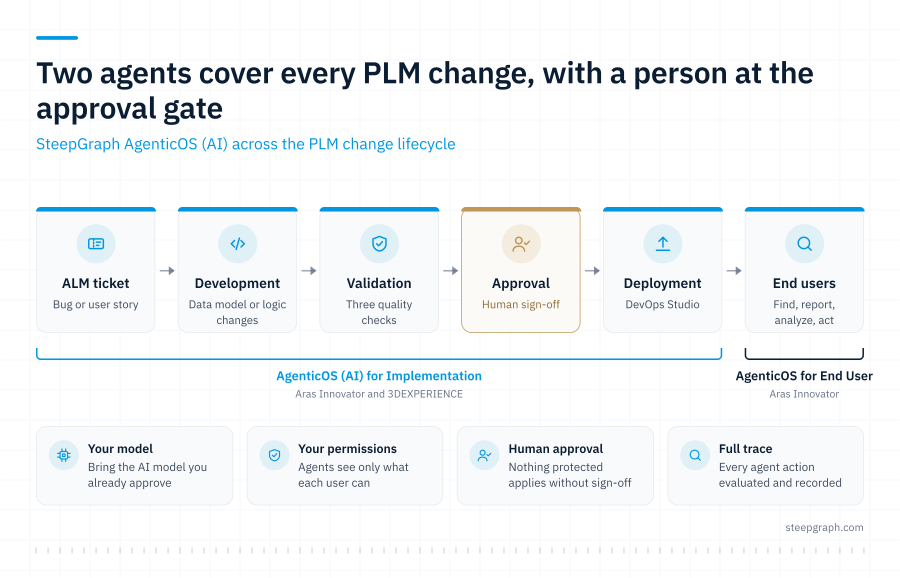
- Bring your own model: Organizations connect the AI model they already use and approve, rather than adopting a new one.
- PLM permissions respected: Agents work only within the access rights each user already has in PLM.
- Human approval for every change: Every protected action stops at an approval gate, and nothing is applied until a person signs off.
- Evaluation and full traceability: Every agent action is evaluated and recorded, providing a complete audit trail.
AgenticOS (AI) for Implementation
AgenticOS (AI) for Implementation supports PLM developers, architects, and delivery leads on Aras Innovator and 3DEXPERIENCE. It reads incoming tickets for bugs, enhancements, and user stories, explains existing customizations, and drafts configuration and code changes to the data model or business logic according to the organization's standards. With its quality configuration enabled, the agent validates its own drafts using Performance Profiler, Q-Checker, and SonarLint, and provides a release-readiness assessment. Once a person approves the change, it is deployed through DevOps Studio.
AgenticOS (AI) for End User
AgenticOS (AI) for End User serves engineers, buyers, planners, and quality teams working in Aras Innovator after go-live. Users ask questions in plain language, such as where a part is used or why a change is blocked, and the agent finds, reports on, and analyzes live PLM data, then acts on it, for example by drafting a summary or filing a report, always within the user's existing permissions.
| AgenticOS (AI) for Implementation | AgenticOS (AI) for End User | |
|---|---|---|
| Who is it for | PLM developers, architects, and delivery leads | Engineers, buyers, planners, and quality teams |
| What it does | Explains, drafts, validates, and deploys PLM changes | Finds, reports, analyzes, and acts on live PLM data |
| Platforms | Aras Innovator, 3DEXPERIENCE | Aras Innovator |
| When it is used | During the build and enhancement | After go-live |
Together, the two agents cover the full cycle of a PLM change, from the initial ticket through development, validation, approval, deployment, and everyday use, with a person in control at every protected step.
Conclusion
AI is becoming an integral part of how products are designed, changed, manufactured, and supported. The organizations that realize the greatest value from AI in PLM will be those that combine the right platform capabilities with clean, connected, and well-governed product data, supported by a structured implementation approach.
SteepGraph is a PLM-focused consulting firm with extensive implementation experience across Siemens Teamcenter, Dassault Systèmes 3DEXPERIENCE, PTC Windchill, and Aras Innovator. SteepGraph helps organizations assess PLM data readiness, prioritize AI use cases, and implement AI capabilities on the platforms they already use, including governed AI agents through AgenticOS (AI).
To explore how AI can strengthen your PLM environment, connect with SteepGraph's PLM experts.
Frequently asked questions
AI in PLM is the use of artificial intelligence on product lifecycle data, such as requirements, BOMs, CAD and change records, to help teams find information, spot issues, and automate routine engineering work.
The main benefits are faster access to engineering knowledge, fewer errors in BOMs and changes, more part reuse, quicker compliance work and shorter product development cycles.
The main challenges are poor or fragmented product data, integration with enterprise systems, protection of intellectual property, building trust in AI outputs, and adapting processes and skills to work with AI.
As of 2026, Siemens Teamcenter offers Teamcenter Copilot and an AI BOM agent, Dassault Systèmes 3DEXPERIENCE offers the AURA, LEO, and MARIE Virtual Companions, PTC Windchill offers the Windchill AI Assistant, and Aras Innovator offers InnovatorEdge AI for building and governing AI agents.
AgenticOS (AI) is SteepGraph's platform for running governed AI agents inside PLM. It supports bring-your-own-model, respects PLM permissions, requires human approval for every protected change, and is available for implementation teams on Aras Innovator and 3DEXPERIENCE and for end users on Aras Innovator.
Yes. The accuracy of AI in PLM depends on the quality of product data. Duplicate parts, missing attributes, and disconnected systems reduce reliability, which makes data readiness the first step for most organizations.
Organizations should begin with one or two measurable use cases, such as knowledge search or part reuse, on their existing PLM platform, establish governance rules early, and track results against a defined baseline before scaling.
Automotive, aerospace and defense, shipbuilding and marine, EPC, energy, industrial equipment, high-tech electronics, and consumer goods benefit most because they manage complex products, capital projects, long-lived assets, and strict regulations.
The main technologies are generative AI and large language models, machine learning, natural language processing, knowledge graphs, retrieval-augmented generation, computer vision, simulation and generative design, and AI agents.
The future is agentic PLM, where AI agents carry out engineering tasks such as BOM and change management inside governed workflows, with people approving key decisions.
About the author
Kajol Jaiswal
Marketing Executive, SteepGraph